

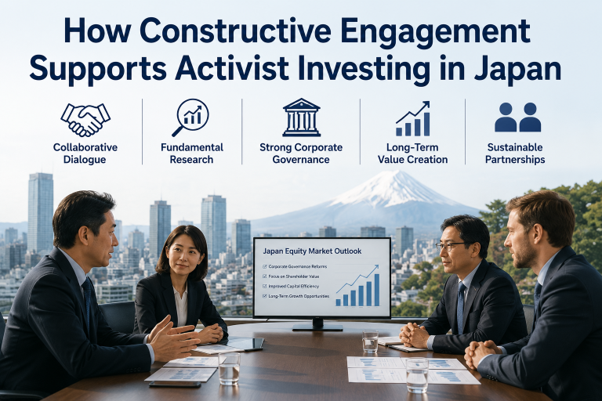
Japan’s equity market has evolved considerably over the past decade, driven by corporate governance reforms, improved transparency, and a stronger focus on shareholder value. As these changes continue to reshape the investment landscape, many investors are recognising the importance of long-term engagement rather than relying solely on short-term market opportunities.
Today, activist investing in Japan is increasingly associated with constructive dialogue, disciplined research, and long-term value creation. Rather than seeking rapid changes, many investors work collaboratively with company management to encourage sustainable improvements. This approach is supported by a well-defined fundamental investment strategy, where investment decisions are based on detailed business analysis rather than short-term market sentiment.
What Is Constructive Engagement?
Constructive engagement is an investment approach that focuses on building productive relationships with company management. Instead of taking an adversarial stance, investors seek to understand a company’s strengths, challenges, and future opportunities before providing thoughtful recommendations that support long-term growth.
The objective is not simply to influence short-term share prices but to encourage decisions that strengthen the business over time. This collaborative approach has become increasingly relevant as Japanese companies continue to place greater emphasis on governance, capital efficiency, and shareholder communication.
Why Constructive Engagement Is Growing in Japan
Japan’s corporate landscape has undergone significant changes in recent years. Reforms aimed at improving governance standards have encouraged companies to become more transparent and accountable while placing greater importance on efficient capital allocation.
These developments have created an environment where investors and management teams can engage in more meaningful discussions about long-term business performance.
Several factors have contributed to this shift:
- Improved corporate governance practices
- Increased focus on shareholder returns
- Greater transparency in financial reporting
- Better capital allocation policies
- Growing emphasis on long-term business sustainability
As a result, constructive engagement has become an important component of activist investing Japan.
The Role of Fundamental Research
Successful engagement begins with understanding the business in depth. Investors cannot provide meaningful insights without first developing a comprehensive view of how a company operates, competes, and creates value.
A disciplined fundamental investment strategy focuses on analysing the underlying quality of a business before any investment decisions are made. Rather than reacting to market fluctuations, investors seek to understand the long-term drivers of performance.
Areas Commonly Evaluated
Fundamental research typically includes:
- Financial statement analysis
- Revenue and earnings trends
- Balance sheet strength
- Cash flow generation
- Industry positioning
- Competitive advantages
- Management quality
- Corporate governance practices
This research provides the foundation for informed investment decisions and constructive engagement.
Identifying Opportunities for Long-Term Value Creation
Not every company requires significant operational changes. In many cases, businesses already possess strong assets but may benefit from improvements in governance, capital allocation, or strategic execution.
Constructive investors carefully evaluate where long-term value can be created while respecting the company’s existing strengths.
Potential Areas of Improvement
Investors may identify opportunities such as:
- Improving capital allocation
- Optimising cash utilisation
- Enhancing operational efficiency
- Strengthening corporate governance
- Increasing transparency with shareholders
- Supporting sustainable growth initiatives
The objective is to encourage improvements that benefit both the company and its shareholders over the long term.
Why Corporate Governance Matters
Corporate governance has become one of the defining characteristics of Japan’s evolving equity market. Strong governance helps companies make better strategic decisions while increasing accountability and investor confidence.
Investors increasingly evaluate governance alongside financial performance because effective oversight often contributes to stronger long-term business outcomes.
Well-governed companies generally demonstrate:
- Independent board oversight
- Transparent reporting practices
- Clear executive accountability
- Disciplined capital allocation
- Long-term strategic planning
These characteristics support sustainable growth and strengthen relationships between companies and their shareholders.
Building Long-Term Relationships with Management
Constructive engagement is built on trust and ongoing communication rather than one-time interactions. Investors who understand a company’s long-term objectives are often better positioned to contribute meaningful insights throughout the investment lifecycle.
Regular dialogue allows investors to better understand management priorities while providing opportunities to discuss governance, strategy, operational performance, and capital allocation.
This collaborative relationship often supports more informed decision-making and encourages sustainable business improvement over time.
Measuring Success Beyond Share Price
The success of constructive engagement should not be measured solely by short-term market performance. Instead, investors often evaluate whether a company has strengthened its long-term competitive position and improved the quality of its business operations.
Indicators of successful engagement may include:
- Improved governance standards
- Better capital allocation decisions
- Increased operational efficiency
- Stronger financial performance
- Enhanced shareholder communication
- Sustainable long-term growth
These improvements contribute to creating lasting shareholder value rather than temporary market gains.
Why Patience Is Essential
Constructive engagement is a long-term process. Meaningful business improvements rarely happen overnight, and sustainable value creation often requires patience, consistent communication, and disciplined decision-making.
A robust fundamental investment strategy supports this long-term perspective by focusing on business fundamentals rather than reacting to daily market volatility. Investors continue monitoring company performance, industry developments, and management execution while maintaining confidence in their long-term investment thesis.
This disciplined approach enables investors to identify businesses capable of delivering sustainable value over many years.
Conclusion
The evolution of activist investing Japan reflects a broader shift towards collaboration, governance, and long-term value creation. Rather than pursuing short-term outcomes, constructive investors focus on understanding businesses, engaging with management teams, and supporting improvements that strengthen company performance over time.
A disciplined fundamental investment strategy provides the analytical foundation for this approach by combining detailed research, thoughtful company evaluation, and continuous engagement. As Japan’s corporate landscape continues to evolve, constructive engagement is likely to remain an important driver of sustainable growth and long-term shareholder value within the country’s equity market.